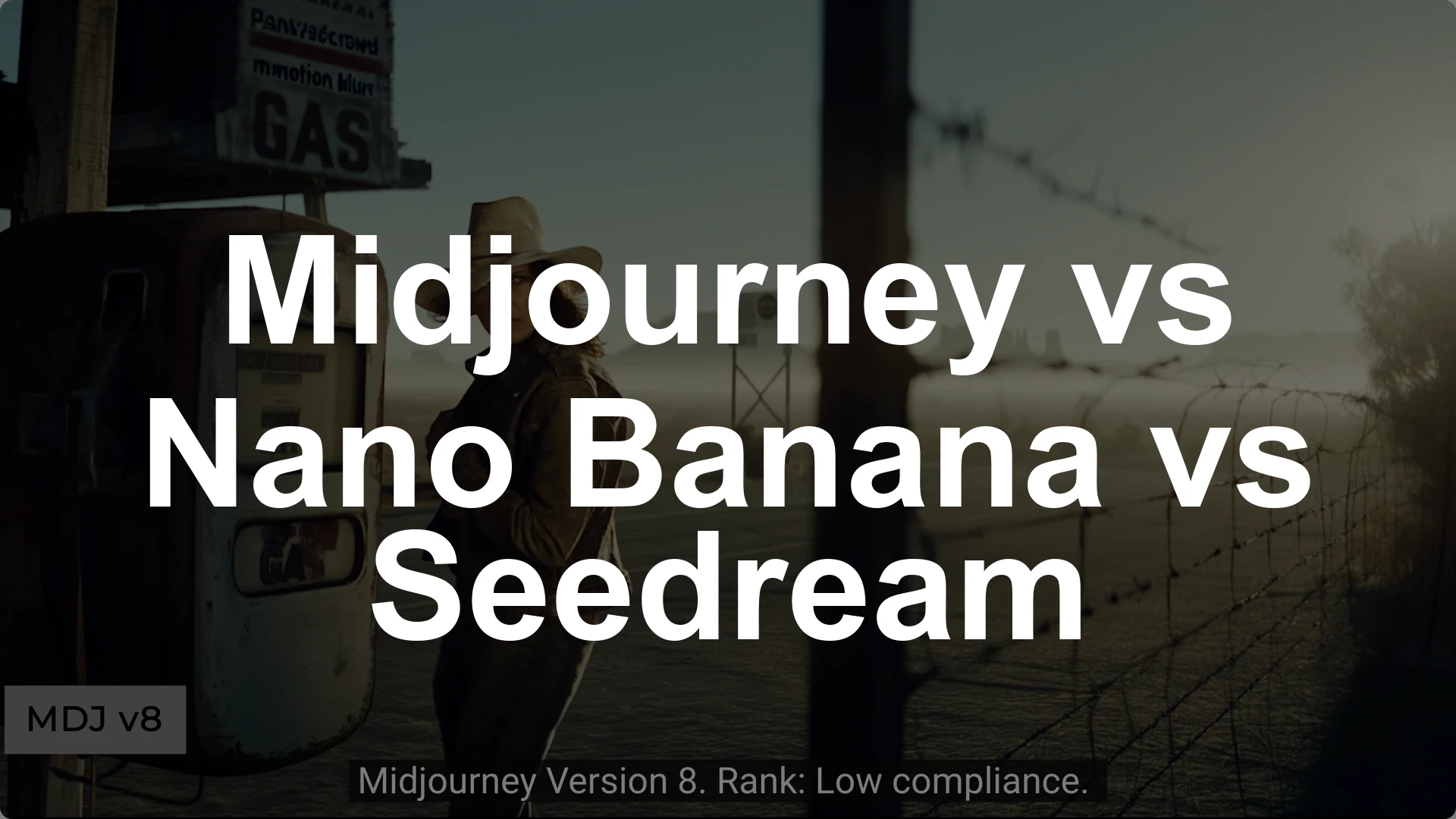
Three models, one question. Which one actually thinks like a film director? Not just making a beautiful image, but designing a shot with intention, tension, and cinematic clarity.
In an unsponsored review, I am testing the brand new Midjourney version 8, Niji Journey 2, and SeaArt 5 light on the three things that separate true cinema from just a pretty picture. Momentum you can feel in your body, staging that creates power and pressure inside the frame, and depth that pulls your eye through layers of space. Four years after the first generation of Midjourney hit the market, we are spoiled by at least a few impressive text to image models.
Which one is the best for AI filmmaking? Which of them obediently listens to your prompts and composes your first frame exactly the way you envisioned it? Because if a model does not do that, it is just a nice picture generator, not a tool fit for AI film production.
I have crafted specific DP cinematography prompts and fed them to all three models. I want to see if they listened to what I asked for and delivered exactly that. For those tracking version shifts, see this comparison of Midjourney V6 and V5.
AI Cinematography Model Comparison: How I Judge Shots
For each shot you decide about lighting, lens, and film stock you want to use. Today I assess the output against five elements I wanted them to execute properly. Intention, momentum, staging, depth, and tension.
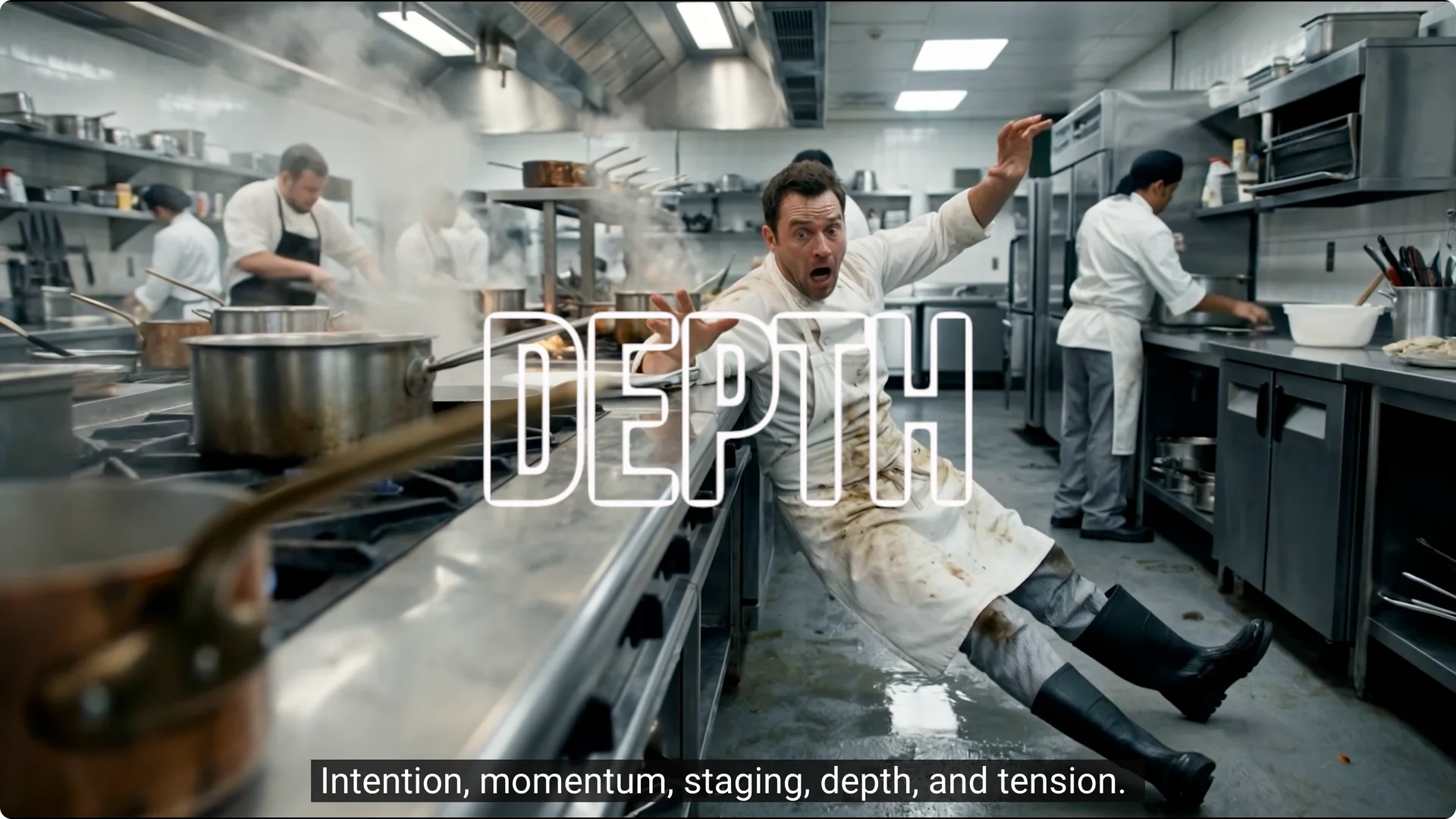
Step 1: Intention is the driving purpose behind every lighting, lens, and placement choice in the frame, ensuring nothing is there by accident. It is what separates a random pretty AI generation from a deliberate storytelling tool. It answers the question, why I took this shot and does it help the viewer read what is happening.
Step 2: Momentum is the physical and visual energy captured within a still image. It is the feeling of weight, speed, and gravity that makes an action shot feel alive and dangerous rather than stiff and posed.
Step 3: Staging, mise en scène, defines how characters and objects are arranged within the frame to dictate relationships and power dynamics. Good staging uses space to show the audience exactly who is in control without a single word. Do not forget the gaze vector, which establishes the visual hierarchy of elements in the frame and guides the eyes.
Step 4: Depth gives the illusion of three dimensional space on a flat screen, pulling the eye from a blurred foreground dirty frame all the way into the deep background along the Z axis. It is the architectural layering that gives a shot massive theatrical scale.
Step 5: Tension is the psychological pressure built directly into the composition before any real action happens. It is the visual weight, often created by harsh shadows and extreme distance, that keeps the audience holding their breath. For a broader field test beyond these three models, see our overview of Flux Pro, Flux Lora, Midjourney, and Mystic.
AI Cinematography Model Comparison: Scene One Desert Gas Station
The purpose is to establish profound isolation and paranoia. I want to know which model can convey that purpose on the first frame.
AI Cinematography Model Comparison: Midjourney Version 8
Rank: low compliance. As much as I love the aesthetics of this frame, Midjourney missed the purpose of the shot. The intentionality is low and there is none of the tension or paranoia I requested.
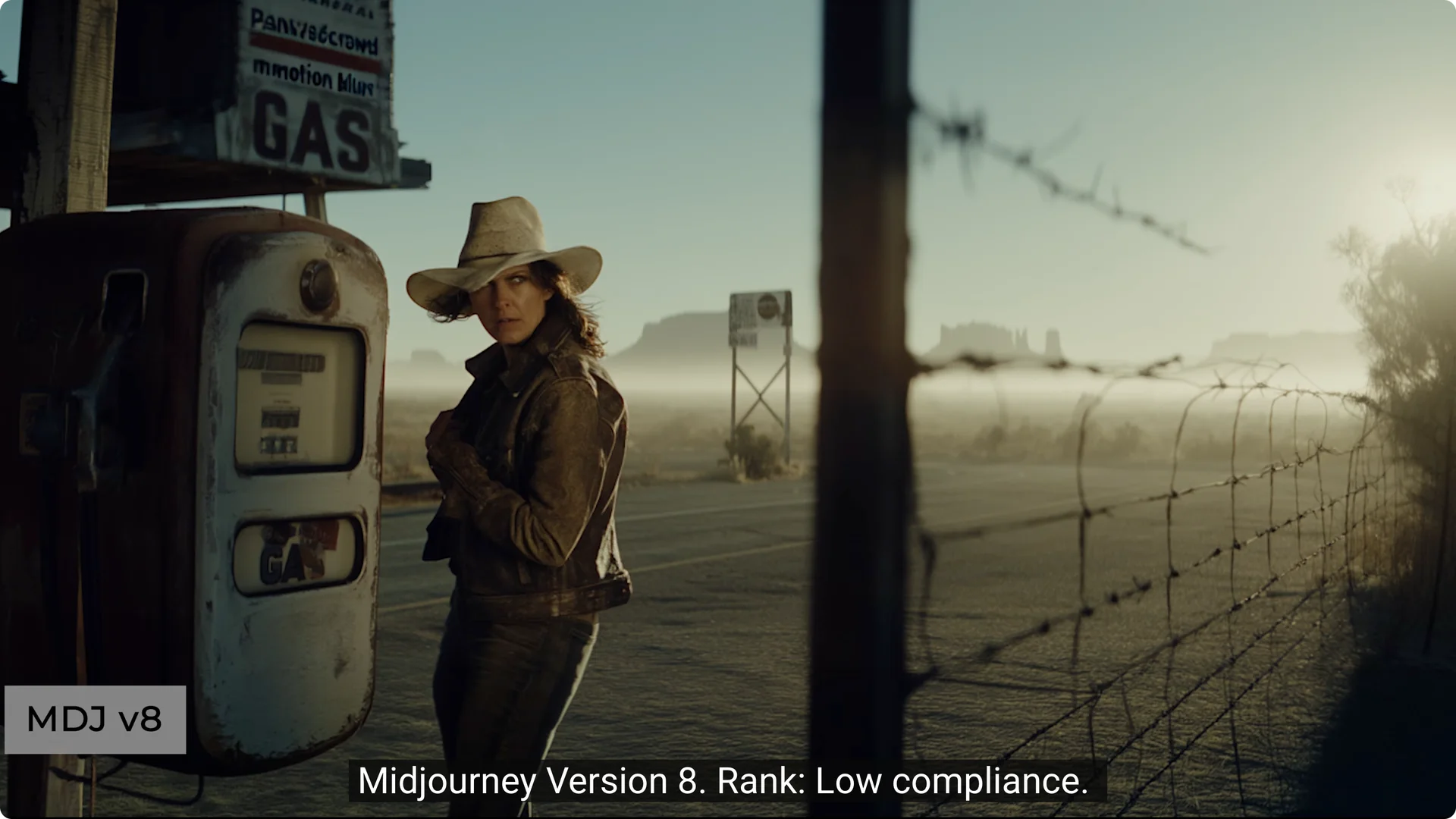
The staging is also partially incorrect. Our hero is looking in the wrong direction, and the frame is totally static with no indication of movement. The woman looks like she is simply filling her tank, and the only tension she feels is the horrifying price of a gallon.
Overall, this frame is a good example of being served a tasty burger when you ordered finger licking fried chicken. It is pretty, but it is not the shot I asked for.
AI Cinematography Model Comparison: SeaArt 5 Light
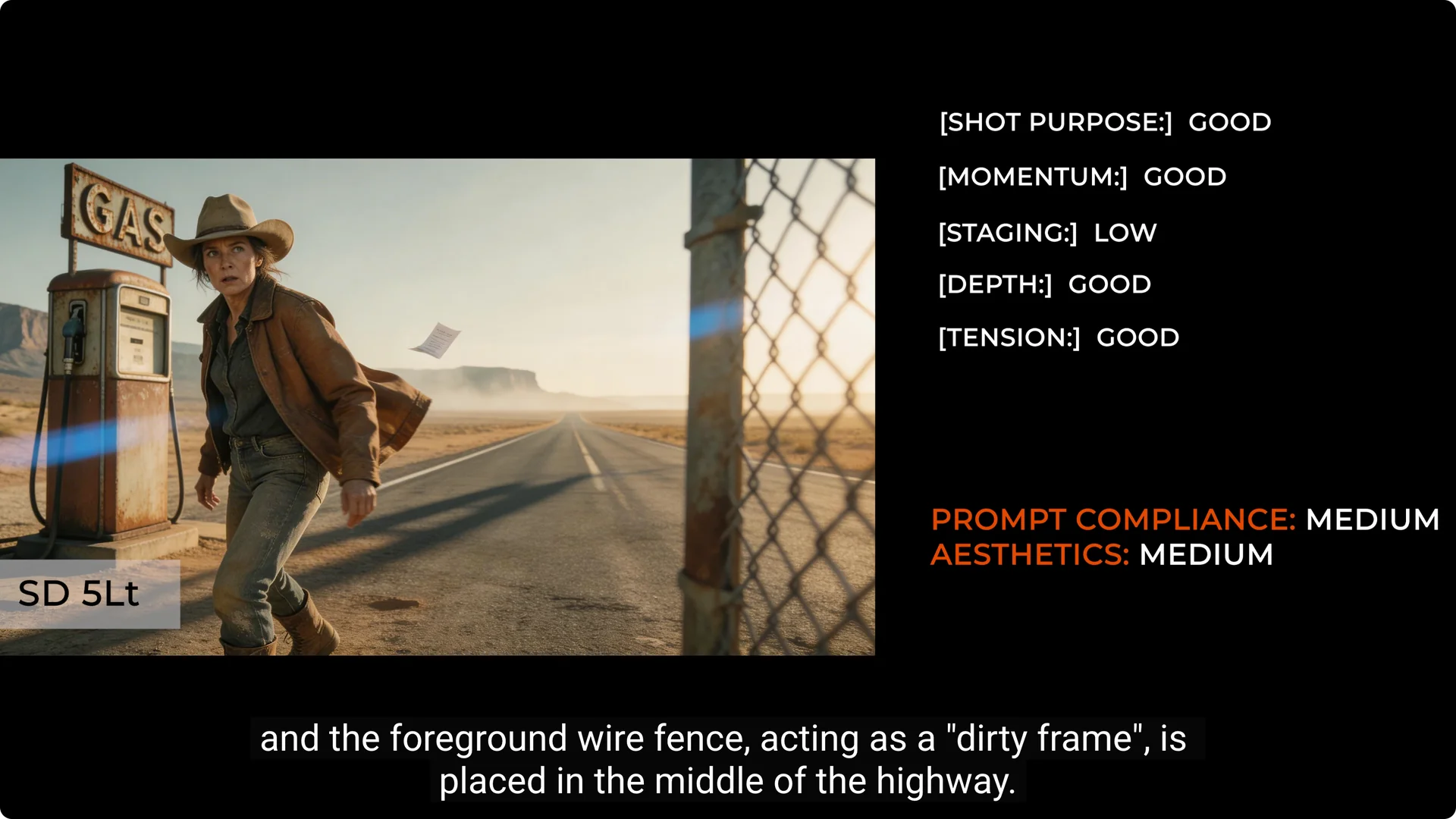
Rank: moderate compliance. SeaArt captures the intention and spatial depth quite well, strictly adhering to the thriller motive. However, there are serious issues with staging.
The gas pump is located almost on the tarmac, and the foreground wire fence acting as a dirty frame is placed in the middle of the highway. SeaArt followed the prompt, but switched off its logic in the process. I am also not impressed with the aesthetics, which carry a plastic AI look I want to avoid.
AI Cinematography Model Comparison: Niji Journey 2
Out of the three first frames generated, the Oscar goes to Niji Journey 2. Rank: high compliance. It perfectly executes high contrast lighting and an oppressive atmosphere while maintaining the exact spatial standoff requested.
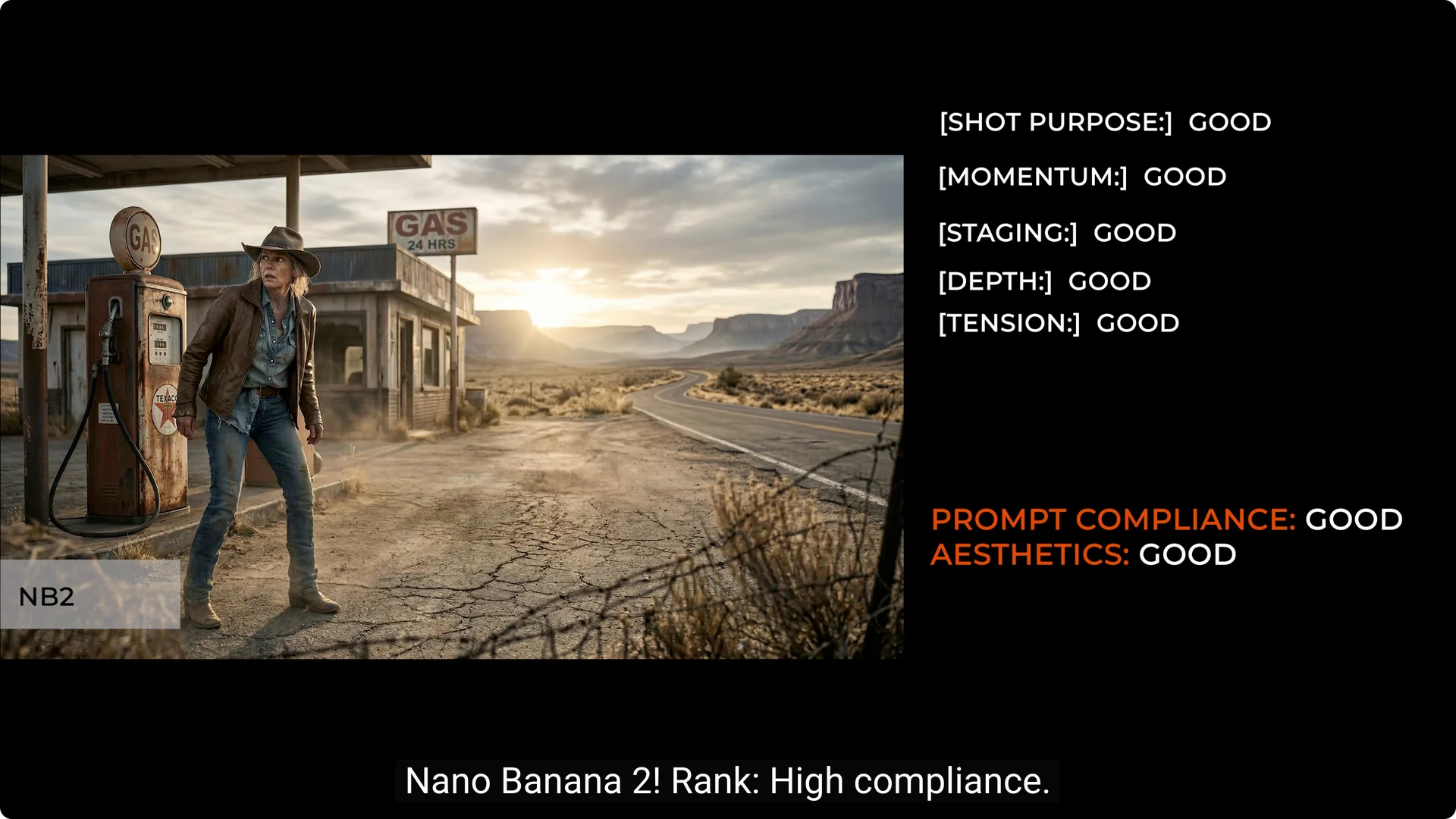
The intention captures the drama and paranoia of the hero. The momentum is convincing, with heavy poised stillness and coiled spring readiness in the foreground subject. The compressed staging impresses by positioning the character in the left third of the frame facing the left edge, which makes the scene feel pressurized and suffocating.
This sparks anticipation for what is hiding off screen, and the viewer expects the next shot to reveal it. Additionally, the gaze vector is perfectly executed. We are led to the subject’s eyes first, follow her gaze to understand the danger, and finally settle on the vanishing point where the leading lines meet.
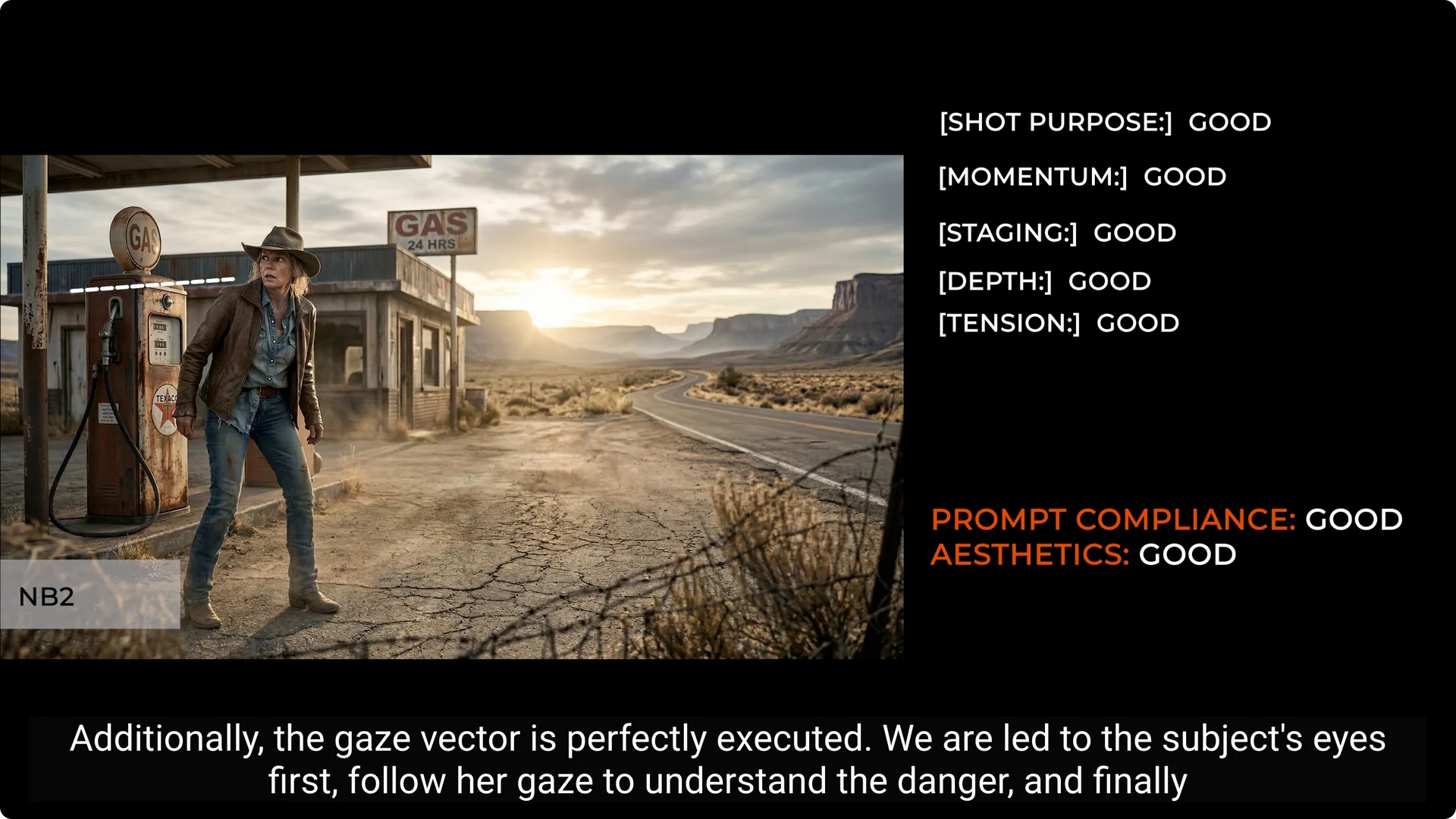
This final glance reinforces the hero’s isolation. This is a prime example of storytelling through composition alone.
AI Cinematography Model Comparison: Scene Two World War II Pilots
The purpose is to visualize the threshold between combat duty and safety using structural and psychological division. I ask for a clear diagonal bisection to make that division read instantly.
AI Cinematography Model Comparison: Midjourney Version 8
Rank: moderate compliance. Midjourney followed the intention, but chose to do it its own way, ignoring the critical diagonal bisection requirement. The psychological division is there and the frame is aesthetically pleasing, but the staging missed the core concept.
AI Cinematography Model Comparison: SeaArt 5 Light
Rank: high compliance. SeaArt adheres to the complex geometric bisection and successfully isolates the subjects. It captures the stark division through rigid structural framing, but loses points on shadows that make no sense.
The depth is well executed, using the propeller as a dirty frame in the foreground. The structure is sound, yet the lighting logic breaks the illusion.
AI Cinematography Model Comparison: Niji Journey 2
Rank: superior compliance. This image captures the heavy stillness and delivers an accurate cinematic mood. The broken wing adds to the atmosphere and conveys the division between the characters.
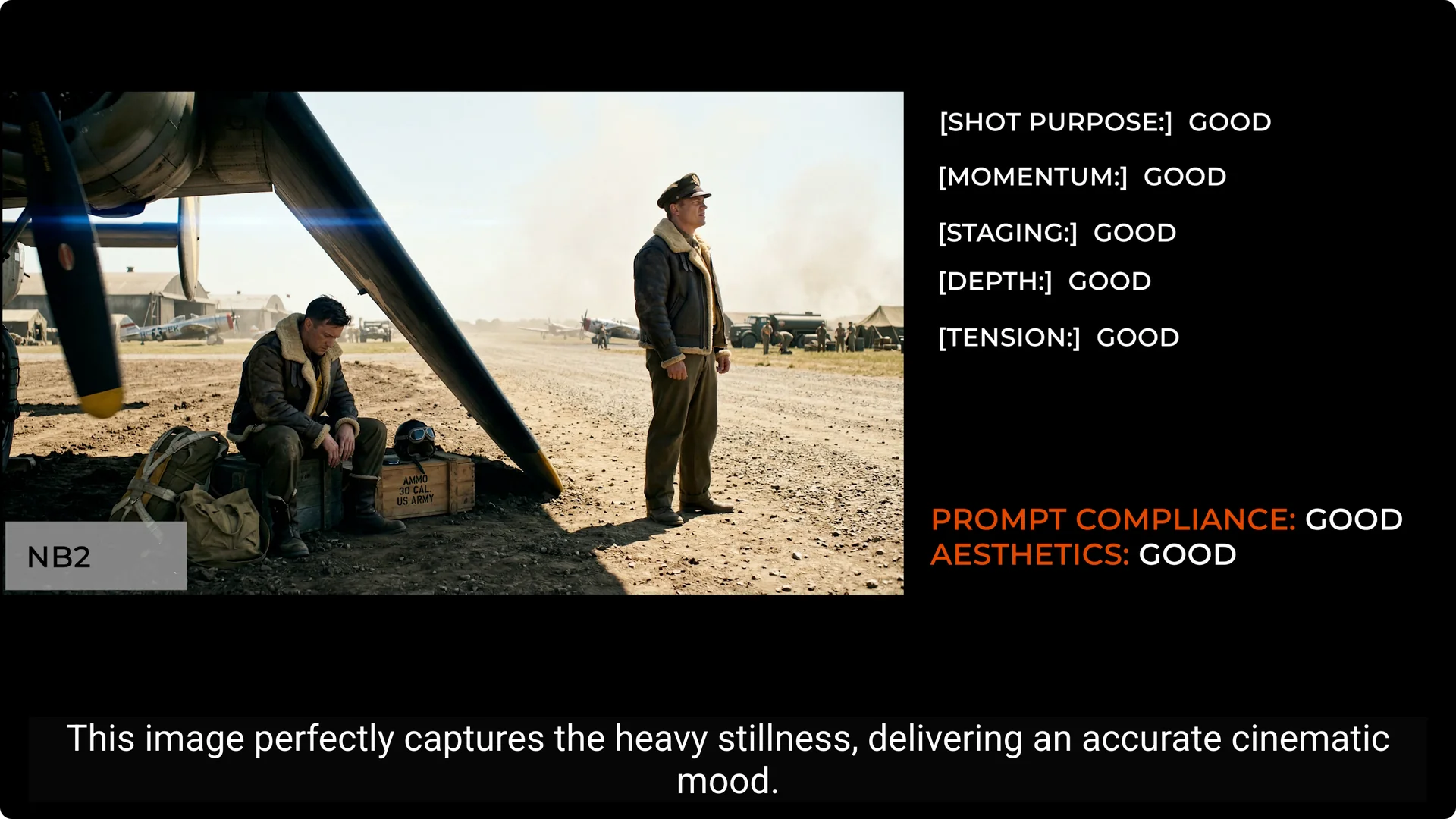
I love the staging and depth. The propeller, receding runway, and hangars create a massive Z axis. The realistic aesthetic of this frame is admirable.
For a look at how Midjourney stacks against another production favorite, see this focused comparison of Midjourney V6 and Leonardo AI.
AI Cinematography Model Comparison: Scene Three Tudor Power Struggle
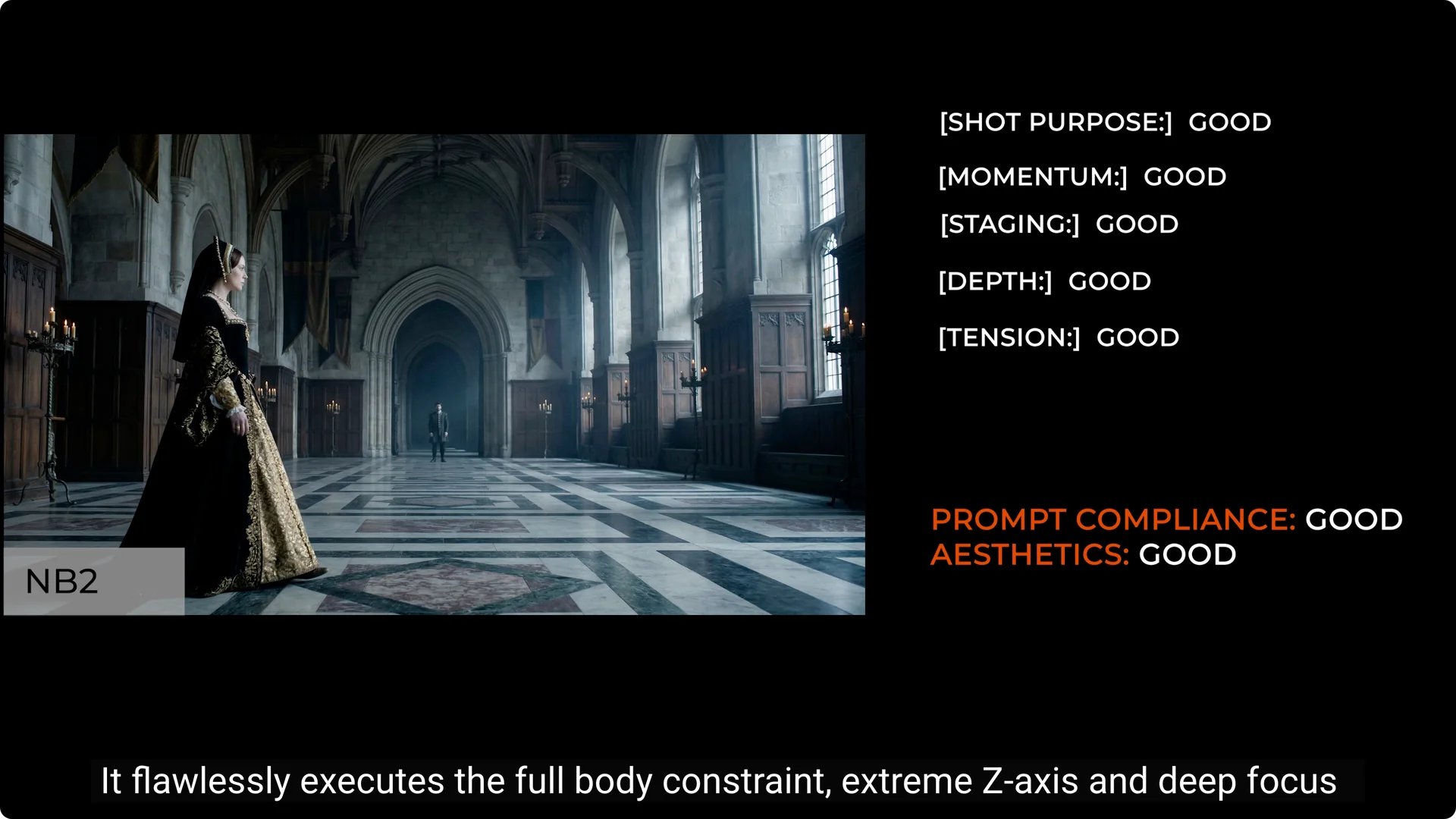
The purpose is to establish extreme emotional distance and visual dominance through severed connection and massive scale difference. The wide shot constraint is key to make dominance read.
AI Cinematography Model Comparison: SeaArt 5 Light
Rank: poor compliance. By ignoring the wide shot constraints and defaulting to a close up, SeaArt loses the intended spatial dominance. The massive scale difference is gone.
As a result, the intention, tension, and depth are all lost. The core ask does not land on the screen.
AI Cinematography Model Comparison: Midjourney Version 8
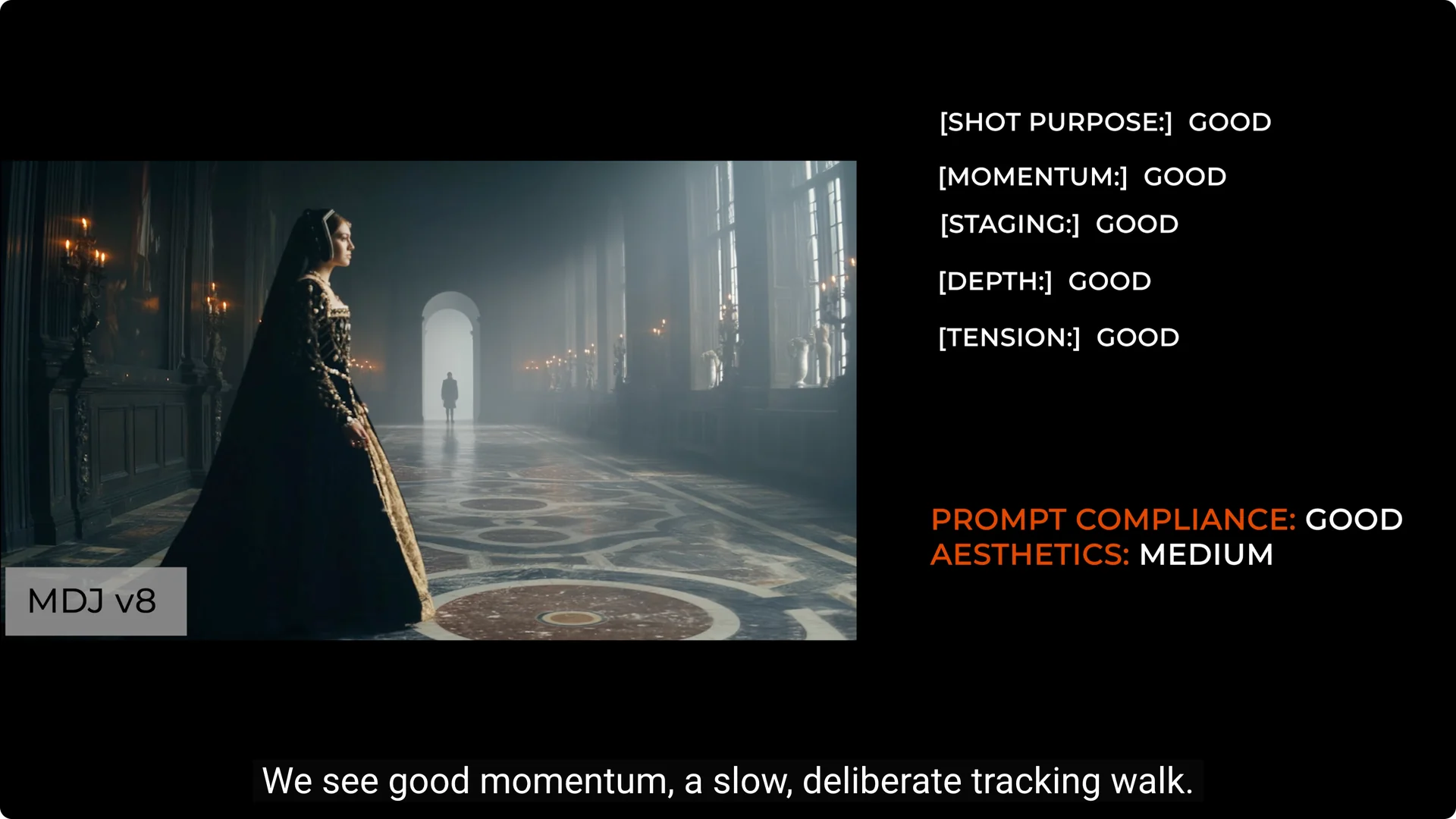
Rank: high compliance. Midjourney performs significantly better here, rendering the scale difference and emotional distance through accurate full body staging. We see good momentum, a slow deliberate tracking walk.
It nails the emotional distance and highlights dominance by using leading lines to execute depth. The frame reads with clarity and purpose.
AI Cinematography Model Comparison: Niji Journey 2
Rank: superior compliance. It executes the full body constraint, extreme Z axis, and deep focus to realize the requested psychological weight. Each element is adhered to, and the result is both prompt compliant and aesthetically strong.
AI Cinematography Model Comparison: Scene Four Frantic Kitchen
The purpose is to capture frantic kitchen chaos and the precise heavy momentum of the split seconds before a crisis. I want kinetic energy that still reads clearly.
AI Cinematography Model Comparison: Midjourney Version 8
Rank: moderate compliance. When Midjourney is asked for high octane momentum, it often uses too much blur, making the image questionable for filmmaking use. Many elements are well executed here, including depth, the dirty frame, and strong leading lines.
Even the terror in the hero’s eyes is convincing. However, the overwhelming blur on his arms and the tray is distracting.
AI Cinematography Model Comparison: SeaArt 5 Light
Rank: high compliance. It maps the spatial layout and depth perfectly, but the chef’s clean apron and mild expression dull the requested chaos. The posture and short sighted framing are well executed and the blurred copper pot anchors the extreme Z axis.
However, the tension could be higher. I do not see enough raw panic and the face looks plastic again.
AI Cinematography Model Comparison: Nana Banana 2
Nana Banana 2 got it perfectly right. Rank: superior compliance. It nails the kinetic skid, environmental interaction, and terrified expression.
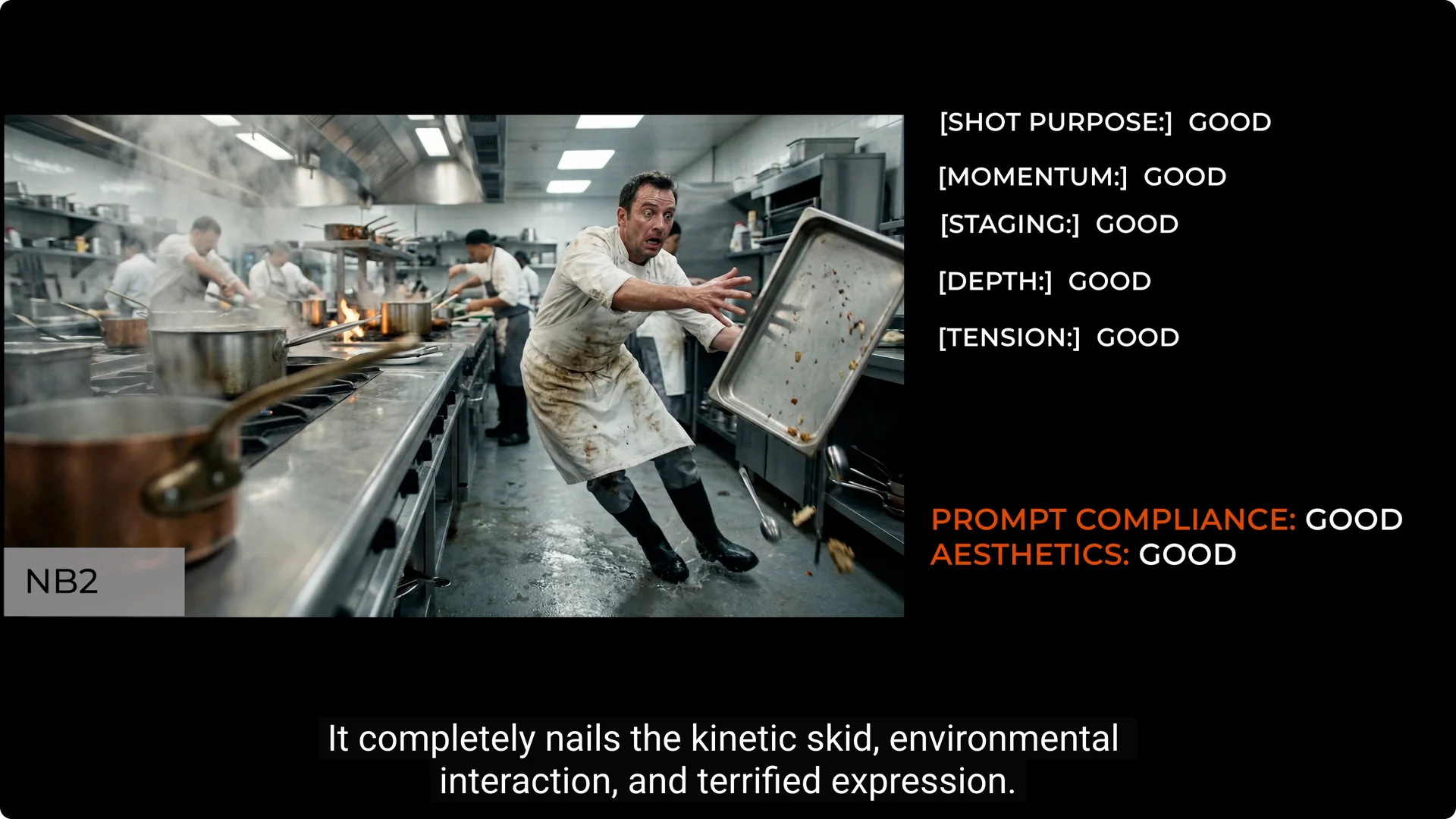
The chef’s apron is stained as requested and the momentum is fantastic. You can practically feel the skid. The tension is spot on, with dilated pupils and physical imbalance making the crisis feel immediate.
If this head to head matters for your workflow, check our concise Nano Banana vs Midjourney breakdown.
AI Cinematography Model Comparison: Verdict
I want to highlight the importance of choosing the right image generation model when composing the first frames for your shots. You want the model that precisely follows your DP cinematography prompt, not just the one that makes the prettiest pictures. The holy grail is a model generating frames that are both perfectly aligned with the prompt and visually spectacular.
With its eighth version, Midjourney continues its legacy of producing atmospheric painting like images that beg to be printed on fine Hahnemühle paper, framed, and hung proudly on the wall. But we are not here for beautiful images alone. We need precise first frames that fit our scene and deliver the exact meaning we want each shot to convey.
When asked to strictly follow a prompt, Midjourney version 8 often struggles and fails to deliver what I actually asked for. It is a generate and erase situation. That is disappointing as version 8 is frequently praised for understanding and following prompts better than version 7.
I understand that version 8 is currently in alpha mode, so I hope these tests will lead to better prompt adherence once the model is fine tuned. SeaArt Dream’s performance was, in most examples, better at reading and following the prompts than Midjourney’s. But I have a problem with the aesthetics of its images.
Characters look a bit too AI generated for my taste and the overall sets lack the richness found in the other two models. It is also worth noting that, as a result of the ongoing legal dispute, the policies built into SeaArt Dream are absurdly strict, often prohibiting generation of totally innocent images. It makes it a horror for any production pipeline.
If I had to choose a first frame generator for any realistic film production today, it would be Nana Banana 2. No doubt about it. While it is not perfect every single time, it is unusually precise at following DP cinematography prompts and offers the most realistic blockbuster like aesthetics.
It seems obvious that this particular image model was built with AI filmmaking in mind. When deliberately prompted with clear intention, it simply spits out frames we are eager to animate right here and right now. Well done, Google.
